The Lighthouse was too easy
Every chapter of Way Out follows one rule: it should be harder to work out than the one before, while the sums stay at a third-grade level. The difficulty has to come from the structure of the puzzles, not from bigger numbers. The Lighthouse was the first chapter built to that rule, and its first playtest showed exactly how easy it is to get it wrong.
Seventeen minutes, no hints
The first player through the Lighthouse finished in 17.4 minutes, with no hints at all. The Observatory's first playtest had taken 33. They said it felt somewhat easier than Chapter 1, which is the one thing a Chapter 2 must not be.
The log showed why. Every lock except the very last opened on the first code they tried, between half a minute and a minute after its clue had been found. The only wrong codes in the whole run were on the final lamp. The slowest part of the chapter was simply finding things: about four minutes went on spotting the sign over the cottage gate and the crowbar in the boat.
Two clues never found, and a finished chapter
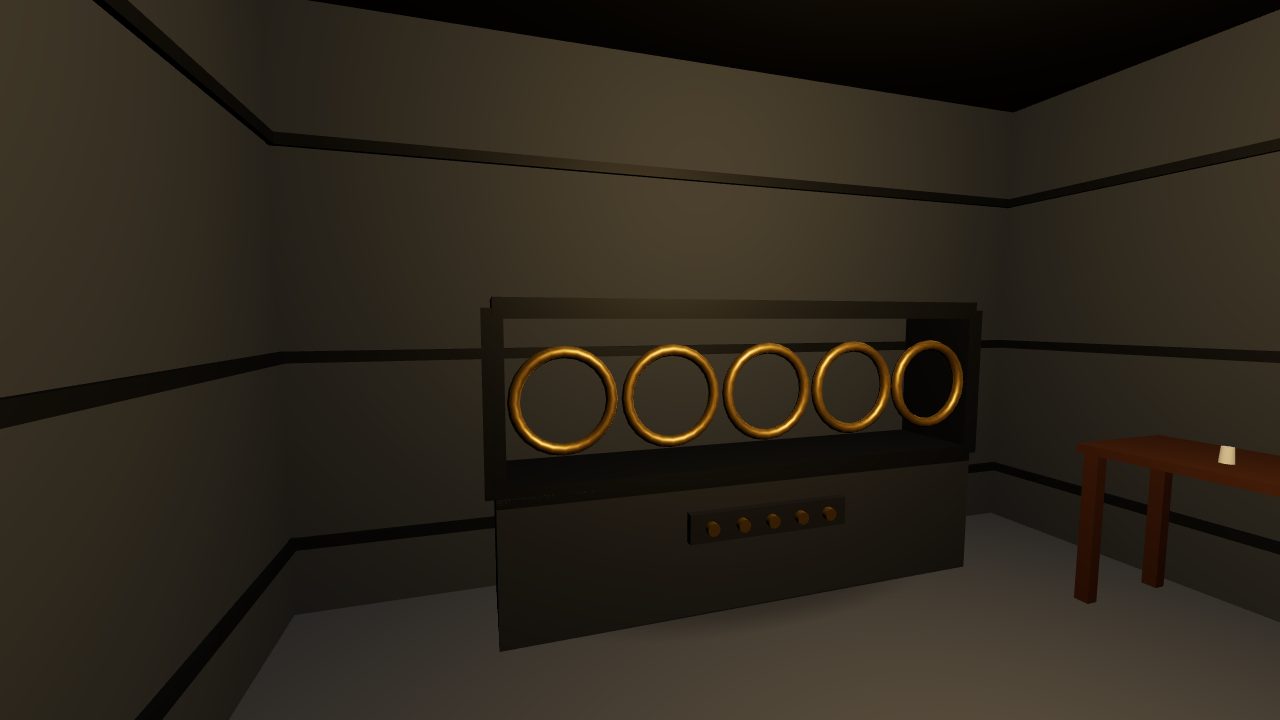
The hardest puzzle in the Lighthouse is the lamp carousel: a row of coloured glasses that has to hang in one particular order, with the rules for that order written on notebook pages hidden around the rock. One page is written in red ink on red lines, and you can only read it through the red glass.
The log said the player had never read that page. They had looked at it four times, and at the red glass once, but never put the two together. They had also never touched the colour chart in the workroom, which turns the colours into the numbers the carousel's dials want.
And yet they solved the carousel on the first try, four seconds after starting on it.
There were two leaks. Without the red page, only two orders of the glasses fitted the remaining rules, so a guess had a coin-flip chance. And the colour chart was redundant: its numbering happened to be exactly the order the glasses were listed in and landed in your pockets. Anyone who simply numbered the glasses in the order they picked them up had the chart's numbers without reading it.
Their wrong guesses on the final lamp fitted the same picture: someone guessing which colour led the carousel, because they had never had to work it out.
Clues that did the work for you
Some of the clues had the same problem in a smaller way. They said which dial was which, in words: the net locker's clue told you it opened with the crabs, then the mackerel, then the lobsters. There was nothing left to work out. Now the clues give the information, and only the lock's own dial labels say what each dial is, so you have to put the two together.
What changed
- Five glasses and six rules, two on each of three pages. Exactly one order obeys all six. Every rule is needed, and without any one page at least eleven orders still fit, so a missing page cannot be guessed around. The game's tests try every possible order to prove all of this.
- A chart you have to read. Its numbering is never the order you pick the glasses up, the order they sit on the rack, alphabetical order, rainbow order or the answer itself. The tests check that too.
- Clues no longer name the dials.
- A nudge for the red page. Holding a glass near the damp page now suggests looking through it.
The lesson
A hard puzzle must not be solvable by luck or by a coincidence in how things are numbered. A clue that can be skipped is not a clue. And if the hardest puzzle in a chapter is solved in seconds, its answer has leaked somewhere.
Since then I read every playtest log looking for clues that were never read in a chapter that was finished anyway. It is the quickest way to find a leak. The real proof that the Lighthouse is now harder than the Observatory will be its next cold playtest.
Play it yourself: The Lighthouse, with its walkthrough, or open the game.
Discussion
No replies yet. Start the discussion: what did you make of it?