Why every game of Way Out has its own answers
An escape game has a weakness that most games do not: once the answers are written down, the game is over. Escape room companies deal with it by never letting you take photos. A game on the web cannot do that. And during playtesting I found out how quickly it matters: playtesters were passing answers to each other.
So since early October every chapter after the Prologue gives each new game its own set of answers.
Same puzzles, different answers
The important word is answers, not puzzles. In every game of the Night Mail there are two notices that disagree, and the drawer wants the date of the later one. What changes is the dates. In every game of the Lighthouse you count the jars on a shelf; what changes is how many there are, how many have fallen over and how many pints the tag says each holds. The Observatory's parrot always tells three riddles, but the numbers in them change. In the Conservatory the gardener's cipher shifts the letters by a different amount, and the sunbeam has a different layout of mirrors and planters. In Station Nine the pins land in different places on the map and the countersign is a different word.
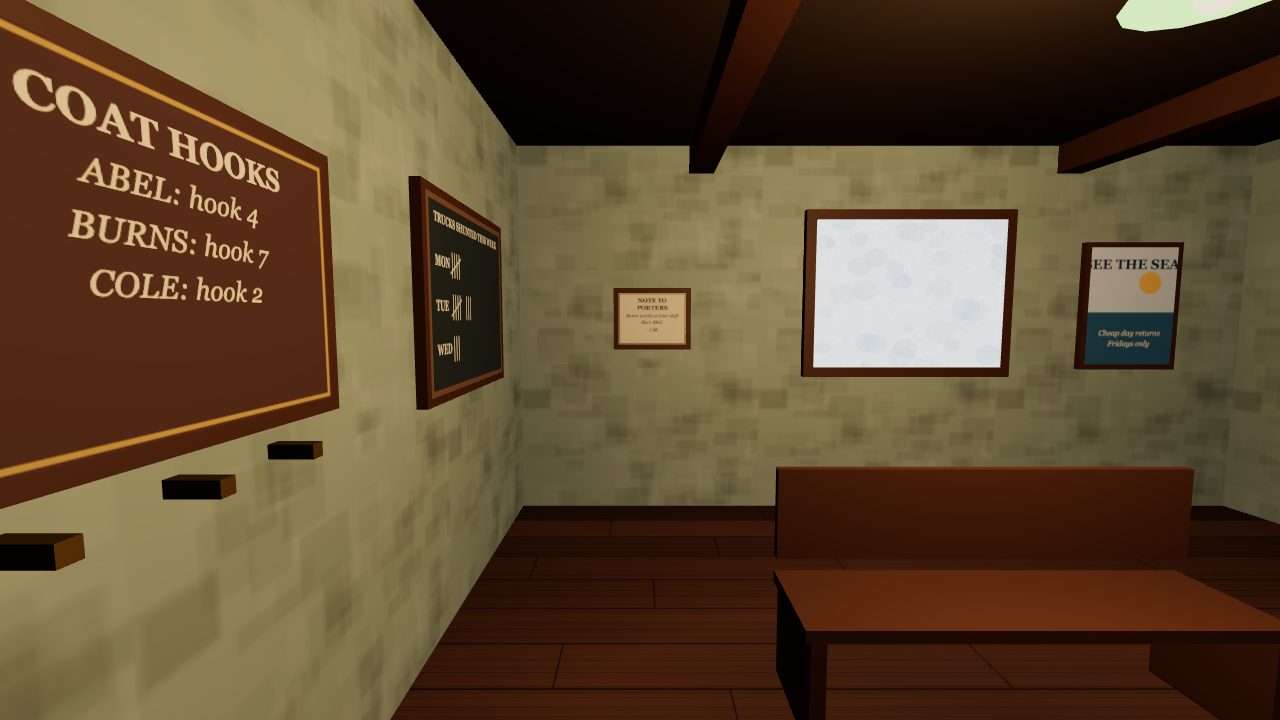
The picture at the top of this page is the coat-hook board from the Night Mail's waiting room. In your game the names and numbers on it will be different, and so will everything that depends on them.
The room has to agree with the words
The hard part is not making up new numbers. It is making sure the whole chapter agrees with them. If a notebook says there are five jars on the shelf, the 3D room had better draw five jars. If the tally slate says how many trucks were shunted on Monday, the marks drawn on the slate have to add up to it.
So each chapter keeps its numbers and words in one place, a small file of facts, and everything reads from it: the text you read, the hints, the locks, and the 3D rooms themselves. When a new game starts, that file is filled in from a random seed, and the rooms are built from the same values as the words. A clue and the thing it describes cannot drift apart, because they come from the same line of code.
Keeping it fair
A few rules make sure the new answers never cost you anything:
- Your device keeps one set of answers per chapter until you finish it. If you start a chapter over, the answers stay the same, so any notes you took are still good. The next time you play it after finishing, you get a new set.
- A save remembers its own answers, so Continue always picks up the same game.
- The Prologue stays the same for everyone, because it is the tutorial.
Testing every game, not just one
Before any of this went live, the tests had to change. They now build chapters with many different seeds and check each one: that the clues and the locks agree, that the solver can finish complete games from start to end, that every lock really does change from one game to another, and that no text anywhere still shows one of the original answers by accident.
That last check is not perfect, and I found a hole in it this week. When you light the Lighthouse's lamp, the game reads the three numbers you set out loud, in words. It was still reading out the original game's numbers in every game, so a player with different answers would solve the lamp and then hear the wrong code. It only happened after the puzzle was solved, but it was wrong. The lamp now reads out your own numbers, and a test checks it for several seeds.
What it means for this site
It is also why the guides here are written the way they are. A walkthrough that lists codes would be no use to you, because your codes are different. So every guide explains how to find each answer: where the clue is, what it means and how it fits the lock. The site's own tests check every page for the answers of several different games and fail the build if one ever appears.
Discussion
No replies yet. Start the discussion: what did you make of it?